
By day three you stop noticing the dust on other people and start noticing it on yourself. It's in your eyebrows and the creases behind your knees. Your feet have gone chalky and tight, and your tent has a fine grey film that transfers to everything you own.
This is normal. Black Rock City is built on an alkali lakebed, there is no plumbing, and nobody is coming to hook you up to water. The 2026 event ran August 30 to September 7 — and the people who plan their hygiene get a good week, while the people who don't spend four days quietly miserable.
Staying clean out there isn't about bringing a shower. It's about bringing the right amount of water, having somewhere legal to put it once it's dirty, and rinsing often rather than big.
Why playa dust is a different kind of dirty
Regular camping dirt is inert. You brush it off and life goes on.
Playa dust isn't. The Black Rock Desert is an alkali flat, and the dust coating you all week is alkaline enough to pull moisture out of your skin. Left on your feet for a few days it produces what everyone calls playa foot: dry, cracked, sometimes painful splits around the heels and toes. Veterans handle it with a diluted vinegar rinse, then moisturizer.
That changes what "getting clean" means. You're not chasing a fresh feeling — you're getting an irritant off your skin before it does damage. That's a rinse job, not a shower job, and it needs less water than you think.
The water math almost nobody does before they leave
Burning Man's official guidance is 1.5 gallons of water per person per day, covering drinking, washing and cleaning — closer to 2 if you're biking across deep playa at 2pm in September.
Run that for one person over seven days:
- 1.5 gal/day × 7 = 10.5 gallons minimum. For two people, 21 gallons.
- Most of it is drinking. In 100°F heat with alkaline dust in your throat, you'll drink more than you expect.
- What's left for washing is maybe a quarter of the total — roughly half a gallon a day.
That number is the whole game. Half a gallon a day for your entire body is not a shower — a home showerhead moves 2 gallons per minute. We broke the numbers down further in how much water you actually need to shower while camping.
Practical example. A camp of four planning seven days should haul roughly 45–55 gallons, and should split drinking water from rinse water before leaving home. Camps that pool everything end up rationing rinses in the back half of the week, because drinking wins every argument.
The rule that actually decides your setup: greywater
Here's the part first-timers underestimate.
Burning Man is a Leave No Trace event, and that applies fully to your dirty water. You cannot dump greywater on the playa — not soapy water, not "just rinse water," not a bucket poured out behind your tent. Dumping untreated water introduces contaminants, turns the clay into slick mud, and violates the event's agreement with the Bureau of Land Management.
Your legal options are to haul it out, take it to an RV dump station, or contract on-site pumping through United Site Services. Burning Man Project doesn't recommend simple flat evaporation ponds either — playa dust coats the black surface and evaporation stalls.
So every drop you use for washing is a drop you have to store, transport and dispose of.
That inverts the usual gear logic. Out here, a smaller water container isn't a limitation — it's what keeps your greywater manageable. A 20-litre solar bag emptied over your head leaves 20 litres you now have to contain for the rest of the week. Five litres leaves five. Across four people and seven days that's the difference between two totes and something nobody plans for — which is why so much greywater quietly ends up where it shouldn't.
Four ways people actually get clean out there
1. Baby wipes and a vinegar spray bottle
The default. Cheap, weightless, zero greywater, and most veterans do some version of it.
Honest assessment: wipes are MOOP — every one goes home in your trash — and they smear alkaline dust around rather than removing it. A stopgap, not a fix for feet. Best for: midday touch-ups.
2. A solar shower bag hung off a shade structure
A black PVC bag, 15–20 litres, warmed by sitting in the sun.
Honest assessment: the heating genuinely works in the desert — that's the one place solar bags deliver. The problems are volume and control. Gravity feed means a weak dribble that wastes water, and you generate 15–20 litres of greywater per use. You also need something that holds 40 lbs where dust storms flatten shade structures. Best for: camps with a shower tent and a real greywater plan.
3. A pressurized hand-pump tank
A sealed rigid tank you pump by hand, then spray through a hose and nozzle.
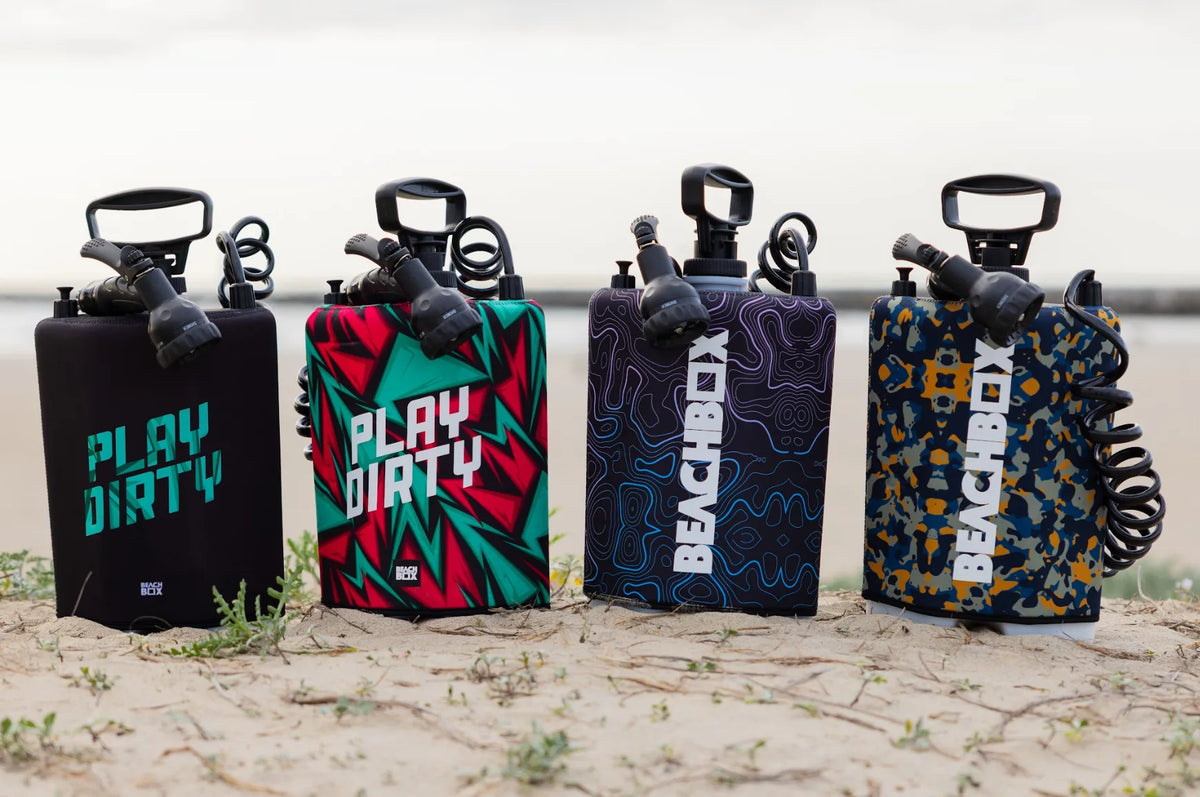
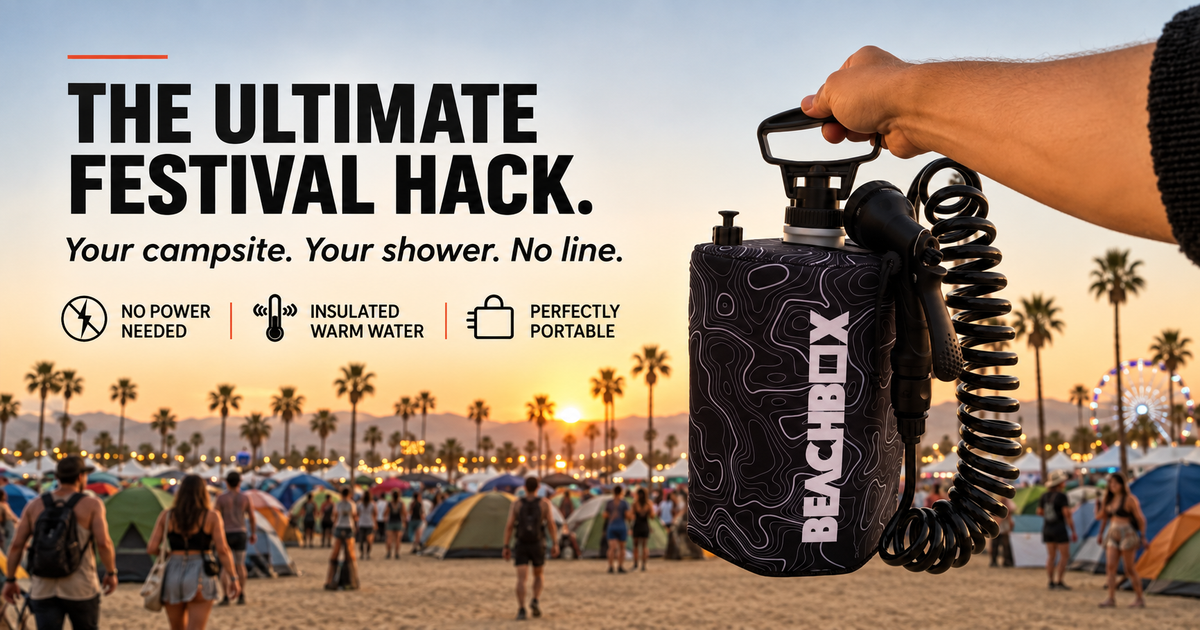
Honest assessment: this fits the greywater constraint best, because pressure lets a small volume do real work. Our BeachBox Shower Tank holds 5 litres (1.3 gallons), takes 15–20 strokes to reach 40–50 PSI, and gives roughly 4–5 minutes of spray through a five-mode gun on a 7 ft hose — enough to rinse two people's feet, legs and hair, or one person head to toe.
The honest limits: it does not heat water — the neoprene sleeve insulates, so fill it warm and it stays warm. It's a rinse, not a power washer. Full it's about 14 lbs, fine when you're driving in. Best for: vehicle camps and most burners who want controlled water use without building infrastructure.
4. Borrowing a camp with a real shower
Some theme camps run proper showers with pumped greywater capture. Excellent if you're in one, not a plan if you're not. If you use someone else's, contribute water or labour.
A rinse routine that doesn't flood your camp
The setup that works is boring and repeatable.
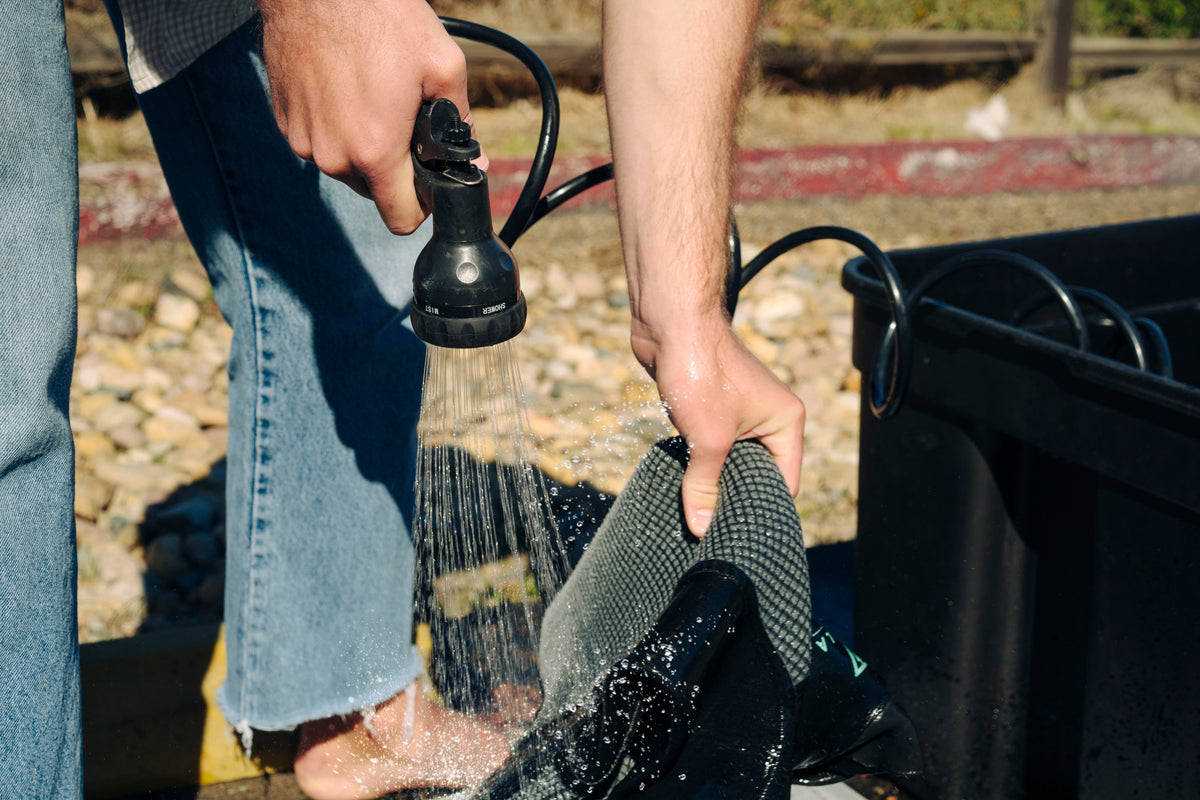
Build a rinse station, not a shower. Put a shallow tub or tarp underneath to catch runoff, sited so you can pour it straight into your greywater tote. A 7 ft hose lets you stand at the tub and aim precisely — no soaked ground, no lost water.
Feet first, every night. The highest-value habit on the playa. Rinse, dry properly, moisturize. Start day one, not day four when they've already cracked.
Rinse before you're filthy. Two short rinses a day beat one long one on both comfort and water use.
Use almost no soap. Soap needs water to remove, and unremoved soap on alkaline skin is worse than dust. A biodegradable drop where it counts is plenty; everything else is water only.
Fill warm at breakfast. An insulated tank holds heat far better than it creates it, so a warm morning fill gives you a warm evening rinse. Same trick applies anywhere off-grid — more in off-grid water tips for long van life trips.
Label the greywater tote and keep the lid on. Open containers collect dust and turn into a smell problem by day five.
What we'd actually pack
One person, seven days: 11+ gallons of water, drinking and rinse supplies stored separately; a 5-litre pressurized rinse tank; a tub or tarp to catch runoff; a sealed, labelled greywater tote; a spray bottle of 1:1 vinegar and water for feet; moisturizer and a towel in a dry bag; biodegradable soap; and wipes as backup.
Not an expensive kit. It's about sequencing — rinse, catch, dispose — decided before you're improvising in the dust at midnight.
FAQ
Can you shower at Burning Man? There is no plumbing or water hookup anywhere in Black Rock City, so there are no showers unless you or your camp bring one. Most people use a portable camp shower, a pressurized rinse tank, or wipes. Whatever you use, you must capture the dirty water — it cannot be dumped on the playa.
How much water do you need per person per day at Burning Man? Official guidance is 1.5 gallons per person per day for drinking, washing and cleaning, and closer to 2 if you're very active in the heat. Over seven days that's at least 10.5 gallons per person, and most goes to drinking — realistically about half a gallon a day is left for washing.
What do you do with greywater at Burning Man? Contain it and remove it. Haul it out, take it to an RV dump station, or arrange on-site pumping through United Site Services. Dumping it on the playa is prohibited — it contaminates the surface, creates mud, and breaches the event's land-use agreement. Burning Man Project also advises against flat evaporation ponds, since playa dust kills them.
What is playa foot and how do you prevent it? Playa foot is the dry, cracked skin that develops from prolonged contact with the alkaline dust of the Black Rock Desert. Prevention is a nightly routine: rinse your feet, neutralize with a diluted vinegar spray, dry thoroughly, moisturize. Start day one — treating it after it cracks is far harder than preventing it.
Is a solar shower bag or a pump shower better for Burning Man? It depends on your greywater plan. Solar bags heat well in the desert but use 15–20 litres per shower and give a weak gravity dribble, meaning far more dirty water to store and remove. A pressurized hand-pump tank uses about 5 litres and gives a controlled spray that's easier to catch and dispose of. For camps without shower infrastructure, the pressurized setup is more practical.
Can you use soap at Burning Man? Sparingly, and biodegradable only. Soap requires water to rinse off, and water is the scarce resource — plus soap residue is what turns greywater into a disposal problem rather than just wet dust. Most experienced burners use a small amount where it matters and rinse the rest with plain water.
The point isn't a shower. It's a routine.
Nobody comes back from the playa saying the highlight was getting clean. But the people who had a good week almost always had a rinse routine, and the ones who suffered figured they'd sort it out when they got there.
Bring enough water. Rinse small and often. Catch every drop and take it home.
If you want a setup built for exactly that — small volume, real pressure, nothing to rig — the BeachBox Shower Tank is $120 with free U.S. shipping and wedges behind a seat. It won't heat your water. It will get a week of alkaline dust off you on about a litre a day.
Still weighing heat against pressure? We compared them in heated vs pressurized camping showers.

Leave a comment
This site is protected by hCaptcha and the hCaptcha Privacy Policy and Terms of Service apply.