
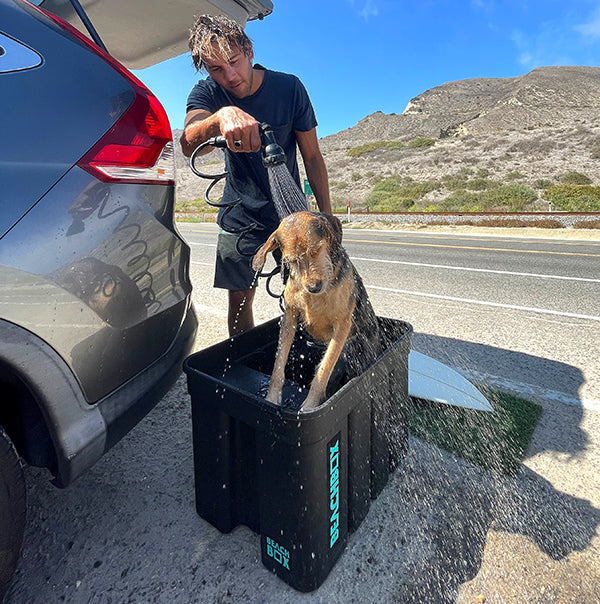
There's a specific moment every dog owner knows. The swim is over, the dog is happy, and he's standing between you and your car with a full coat of lake water and a look that says he's about to shake.
You have roughly four seconds to decide what happens next.
Most people lose that moment. They towel the dog badly, load him wet, and then spend the next week finding sand in the seat rails and wondering why the car smells like a pond. The rinse itself isn't hard — it's a five-minute job. The mess is what people actually get wrong, and the mess is almost entirely a sequencing problem.
Here's how to do it properly, whether he came out of the ocean, a lake, or the neighbor's pool.

Why Rinsing After a Swim Actually Matters
This isn't fussiness. Each kind of water leaves something behind that you'd rather not have sitting against your dog's skin for the rest of the day.
Saltwater
Salt dries into a fine crust down at the skin, and it's itchy. Dogs deal with itchy by licking, and a dog licking salt off his own coat for an hour is a dog who's going to end up with an upset stomach. Salt is also hard on a coat over a season — it dulls it and dries it out.
Lake and pond water
Freshwater is the one people underestimate. Algae, silt, and whatever runoff is in that particular lake all end up in the undercoat. The classic "wet dog smell" that won't leave a car is bacteria in a coat that never fully dried out. If you've swum somewhere with a visible algae bloom, a rinse stops being optional — get the water off him and don't let him lick it.
Chlorine
Pool chemistry is easier on a dog than most people fear, but chlorine does dry out skin and it will bleach and stiffen a lighter coat over a summer of daily swims. It also concentrates as the water evaporates, so the longer it sits, the more irritating it gets. A rinse takes it off before it does.
The ears, in all three cases
Whatever the water was, some of it went in his ears. Floppy-eared dogs — spaniels, retrievers, hounds — hold moisture in the canal, and that's where ear infections start. The rinse doesn't fix this. Drying afterward does, and it's the step people skip.
What You Need at the Car
The gear question is simple: you need clean water, some way to move it with a bit of pressure, and no assumption that there's a hose in the parking lot.
Most beach and lake access points either have no rinse station or have one that's a cold trickle with six people in line. Gravity bags hung off a car door produce a dribble that wets sand in place instead of flushing it out. A jug poured over a dog just runs off the top of the coat.
What works is pressurized water you brought with you.
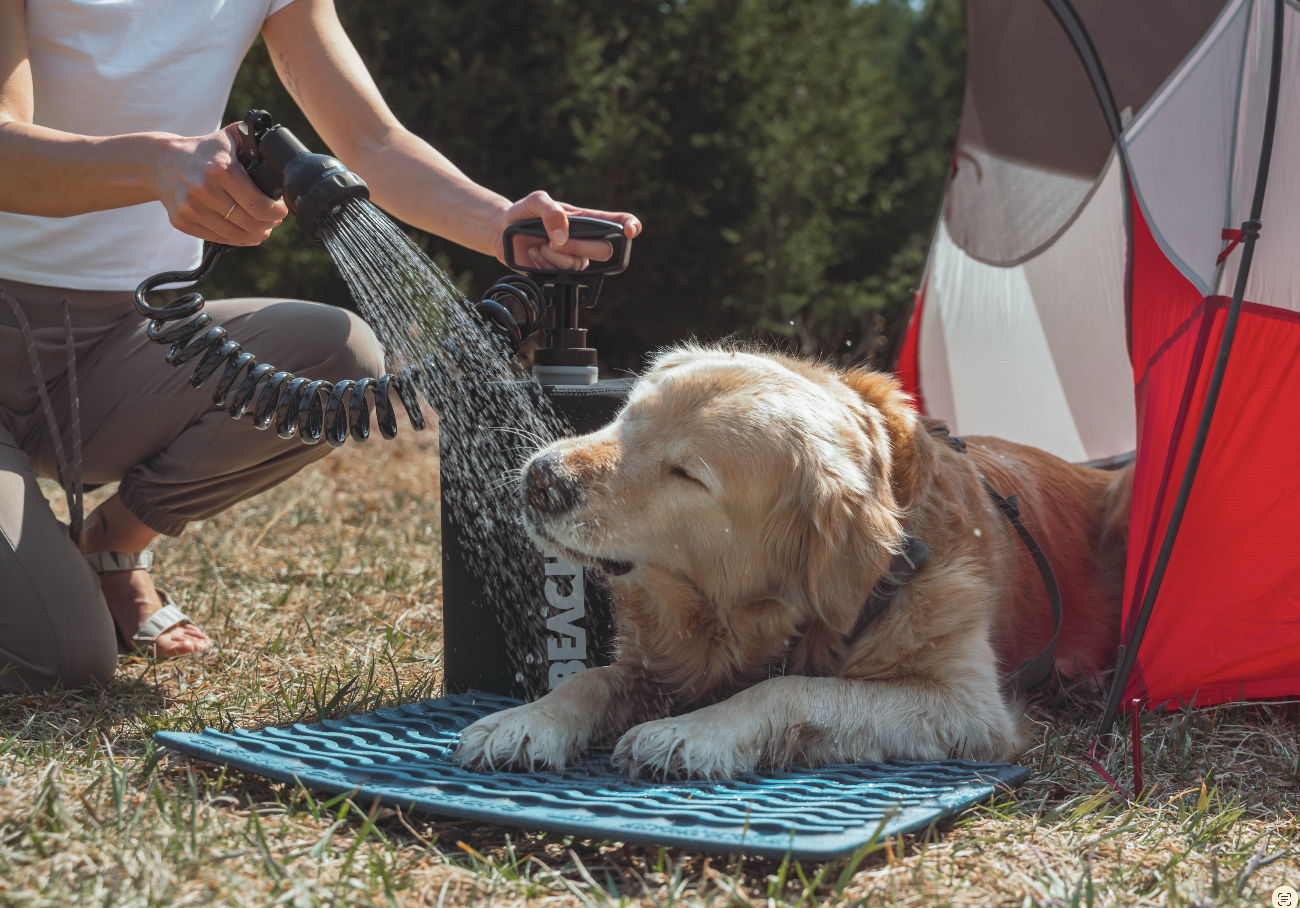
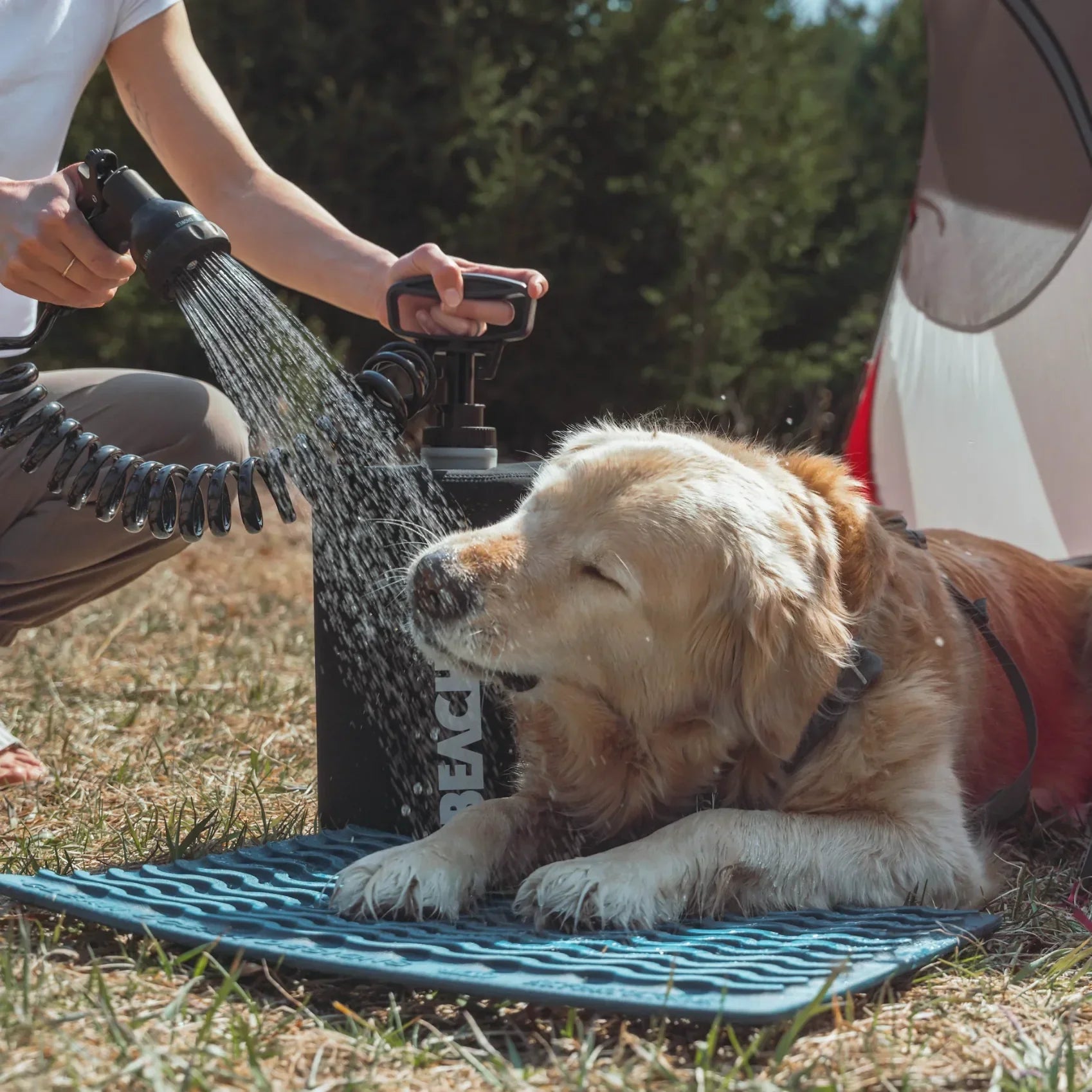
The BeachBox portable shower tank holds 5 liters and pressurizes with 15 to 20 strokes of the built-in hand pump — no hose, no battery, no outlet. The spray gun has five patterns, which matters more with a dog than with a person: a wide spray to wet the coat down, a tighter one to push water through a thick undercoat where sand hides. Let go of the trigger and the water stops instantly, which is the difference between using 2 liters and using 5.
The tank is wrapped in neoprene insulation. Fill it with warm water at home before you leave and it'll still be comfortable when you get back to the car, usually for an hour or two. It's worth being precise about this: it is not a solar shower and it does not heat water itself. The insulation just holds the temperature you put in. That matters for dogs specifically, because a cold blast is how a dog learns to hate the tailgate, and a dog who bolts doesn't get rinsed.
If you're weighing options more broadly, we compared the whole category in our guide to the best portable dog wash for after the beach or trail.
The honest limit: this is a rinse, not a power washer. It flushes salt, chlorine, lake water, sand, and light mud out of a coat and handles a full soap-and-rinse on a medium dog. It won't strip caked bog mud off a Newfoundland. Know which job you're doing before you leave the house.
The Five-Minute Rinse, In Order
Sequence is everything. Do these in the wrong order and you're wearing the swim.
1. Tie him off before you touch the water. Bumper, tow hook, tree, fence post — anything that isn't your wrist. A wet dog's first instinct is to leave, and you need both hands.
2. Pick your ground. Rinse on gravel, grass, or sand, and stand upwind. Don't do it directly behind an open hatch — that's how the shake ends up inside the car.
3. Shoulders first, never the head. Water on the face triggers the shake reflex instantly. Start at the shoulders and work back and down along the spine, then the sides.
4. Let him shake once, on purpose. Halfway through, step back and give him room. He's going to do it regardless; the only question is whether you chose the moment or he did.
5. Belly, legs, and paws. This is where the sand and silt actually collect, and it's what touches your upholstery. Lift each paw and rinse between the pads — grit lodges there and it's the most common reason a dog licks his feet raw after a beach day.
6. Head and face last, on the widest setting. Low pressure, quick pass, avoid spraying directly into the ears or eyes. A damp cloth over the muzzle is honestly better than a spray for most dogs.
7. Dry the ears. Cotton ball or the corner of a towel, just the outer ear and the entrance to the canal — never push anything down into it. Ten seconds here prevents the vet visit.
8. Towel the legs and belly, air-dry the back. The underside is what contacts your seats. The topline can drip.
Water budget: about 2 liters for a medium dog if you're efficient, 3 or more for a thick double coat. A single 5-liter fill covers most dogs with enough left over to rinse your own feet. We ran the full numbers in our guide to how much water a shower actually takes.
Soap: Usually Skip It
For a plain saltwater, lake, or pool rinse, fresh water alone is enough. Shampooing a dog every time he swims strips the natural oils out of his coat and leaves the skin drier than the salt would have.
Save soap for actual mud or the dead-thing-on-the-beach incident. When you do use it, use a dog-specific shampoo — human shampoo is the wrong pH for canine skin and will cause exactly the itching you were trying to prevent. And rinse it out completely. Leftover shampoo residue irritates more than the swim ever did.
Keeping the Car Clean
The rinse is half the battle. The other half is the twenty feet between the tailgate and the seat.
- Rinse before he's near the car, not next to it. The most common mistake is doing the whole job with the hatch open.
- Give the shake room. One deliberate shake at a distance beats three unplanned ones in the cargo area.
- Dry legs and belly properly. Everything else can drip; those two touch fabric.
- Use a real barrier. A waterproof cargo liner or a fitted seat cover, not a beach towel that slides. Towels move the moment the dog does.
- Crack the windows on the drive home. A wet coat in a sealed car is how the smell sets in.
- Rinse your own feet too, while you're there. Same tank, same 30 seconds. If you've got kids in the mix, the same logic applies to the whole crew — we covered the full routine in the best beach setup for families with young kids.
Frequently Asked Questions
Do I need to rinse my dog after every swim?
After saltwater and pool water, yes — salt and chlorine both dry on the skin and cause itching. After clean freshwater, a rinse is helpful but less urgent, though it still cuts down on wet-dog smell and gets silt out of the coat. If there was any algae in the water, rinse without exception and don't let him lick himself before you do.
Is chlorine bad for dogs?
Properly balanced pool water isn't dangerous for a dog to swim in, and a few mouthfuls won't hurt him. The real issue is skin and coat: chlorine strips natural oils, dries the skin, and can dull or stiffen a lighter coat over a season of regular swims. Rinsing with fresh water right after he gets out prevents nearly all of it.
How much water does it take to rinse a dog?
Around 2 liters for a medium short-coated dog, 3 to 4 for a large or double-coated one. The variable isn't the dog so much as the equipment — a trigger you can release between passes uses roughly half what a continuously running stream does.
Should I use warm or cold water on my dog?
Lukewarm. Cold water isn't harmful to a healthy adult dog, but it makes him want to leave, and a dog who won't stand still doesn't get properly rinsed. Warm-fill an insulated tank at home and the temperature holds well enough for the drive out and back.
How do I stop my dog shaking water everywhere?
You don't — you time it. Tie him off, get clear of the car, and deliberately trigger the shake mid-rinse by stepping back and giving him space. Rinsing the head last also helps, since face contact is the main shake trigger.
Can I rinse my dog at the beach without a hose?
Yes, and most beaches leave you no choice. A pressurized portable shower tank you fill at home gives you 5 liters of clean water at the car with no hookup, which is more than enough for a dog plus your own sandy feet.
The Short Version
Bring your own water, tie him off, work shoulders-to-tail with the head last, let him shake once on your terms, and dry the ears and legs before he gets in the car. That's the whole method, and it takes about five minutes.
The gear part is just having clean, pressurized, not-freezing water where you park. The BeachBox shower tank is $120 with free U.S. shipping (excluding HI and AK) — no hose, no power, no setup, and it lives in the trunk between swims.
Get the rinse right and the swim stops costing you a clean car.

Leave a comment
This site is protected by hCaptcha and the hCaptcha Privacy Policy and Terms of Service apply.