
There's a moment every dog owner who camps knows. It's day two. Your dog has been swimming in a lake of unknown provenance, rolled in something you'd rather not identify, and is now at the tent door with an expression that says let me in. You have one towel left. It's your towel.
Camping with a dog isn't harder than camping alone. It's just different, and most of the difficulty comes from a handful of predictable problems that the right gear solves outright. The wrong gear — and there is a lot of it — takes up space in the truck and solves nothing.
This is the list that actually earns its place. No thirty-item roundup, no gadgets you'll use once.
Start With the Real Problem: Your Dog Gets Filthy and Stays Filthy
At home, a dirty dog is a five-minute problem. You have a hose, a bathtub, a drain, warm water. At a campsite you have none of that, and campground rules almost universally forbid washing animals at the potable water spigot or in the bathhouse — for good reason, since that's where people fill drinking water.
So the dirt compounds. Sand goes in the tent. Lake water goes on the sleeping bag. By day three your dog smells like a wet basement and your gear smells like your dog.
What actually fixes it
A portable, pressurized rinse. Not a jug you tip over the dog's back — that dumps water in one spot, soaks the ground, and misses everything. You need pressure and a spray you can direct, because the whole job with a dog is getting water into the coat and grit out of it.
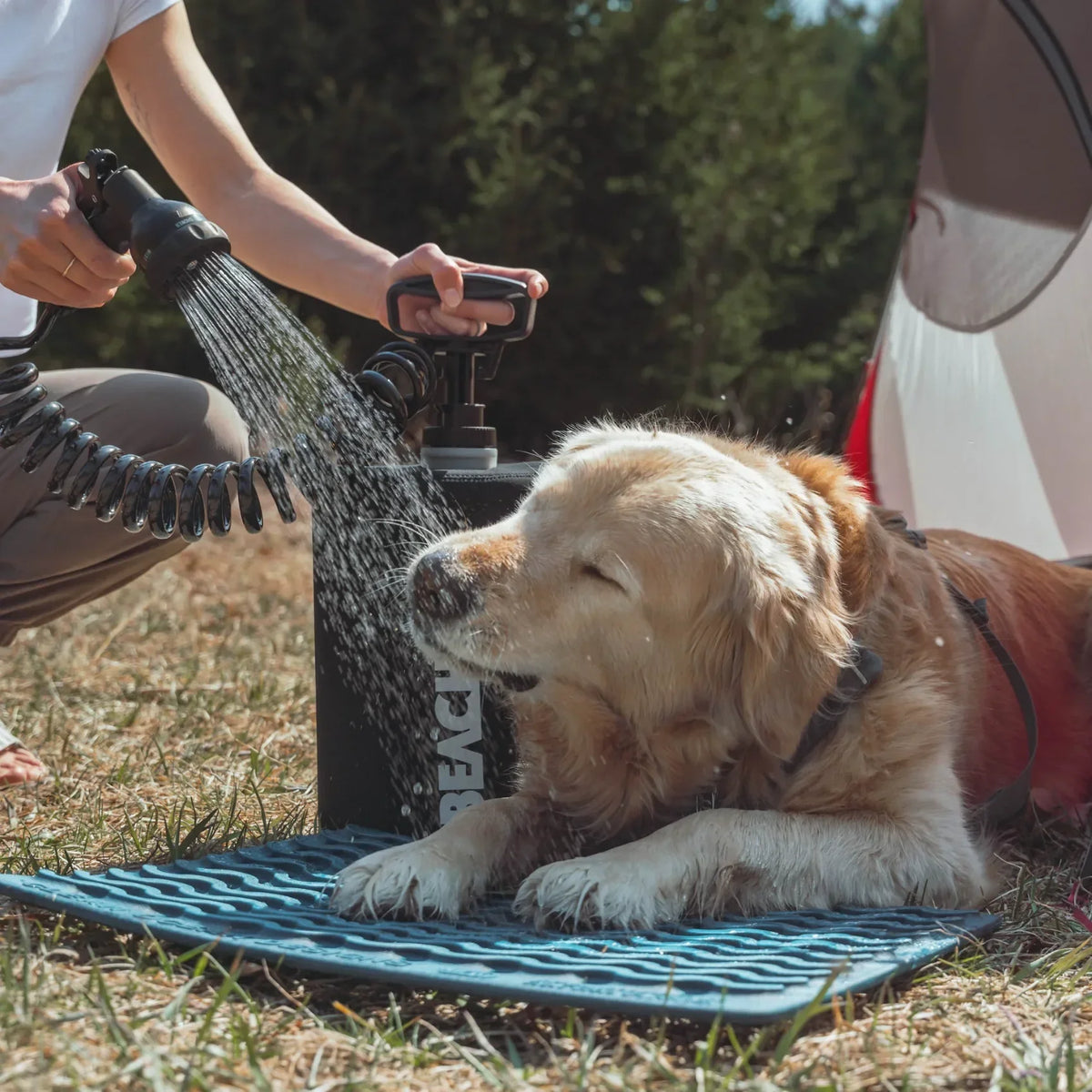
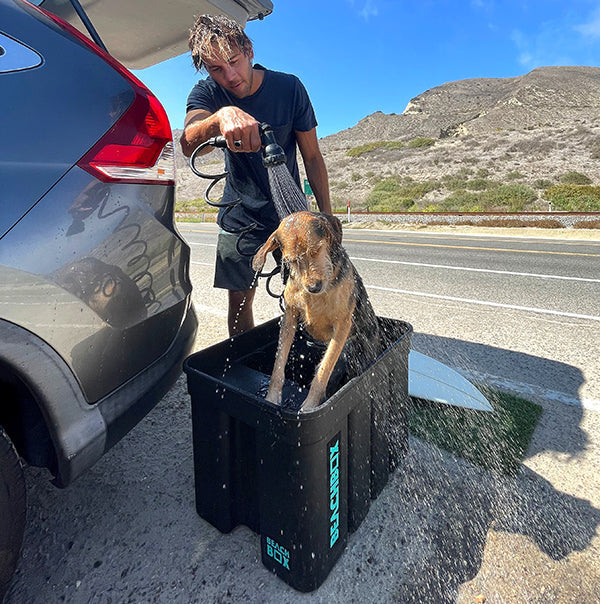
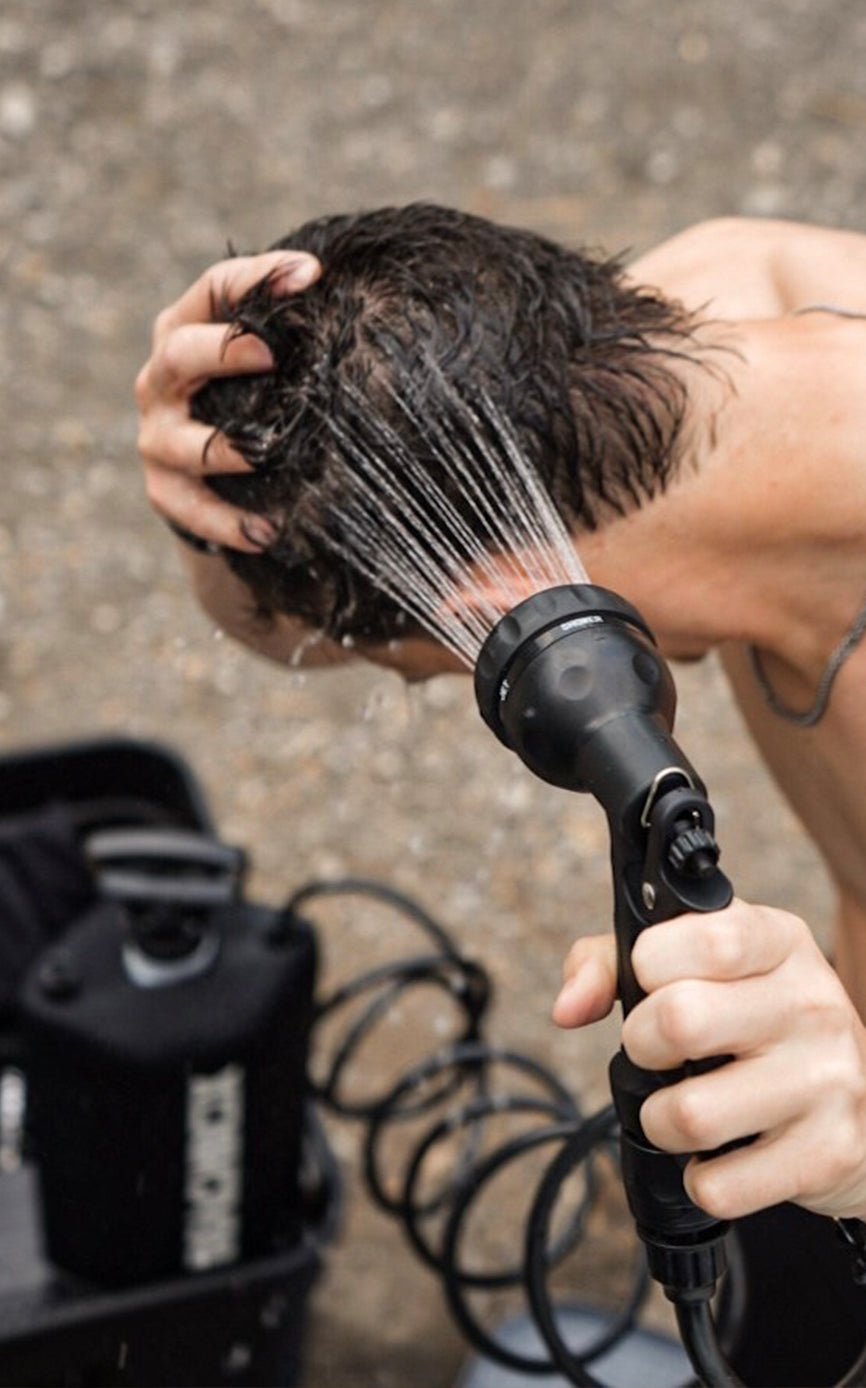
The BeachBox portable shower tank is built for exactly this. It holds 5 liters, you pressurize it with 15–20 strokes of the hand pump to roughly 40–50 PSI, and the five-mode spray gun lets you drop from a firm jet on muddy paws to a soft mist over the face and ears. No hookup, no power, no plumbing. It lives in the back of the vehicle and you use it at the tailgate.
The tank is neoprene-insulated, which matters more than it sounds. Fill it with warm water in the morning and it's still warm hours later when you actually need it. It doesn't heat the water itself — nothing about it is solar or electric — but it holds the temperature you give it, and a dog that isn't being blasted with cold water is a dog that stands still.
One honest limit: it's a rinse, not a power washer. It will pull sand, salt, lake silt and surface mud out of a coat easily. It will not blast dried clay off a Newfoundland. Set expectations accordingly and rinse before things dry.
We went deep on the technique in How to Rinse a Dog After Swimming (Without Making a Mess) and on the gear comparison in Best Portable Dog Wash for After the Beach or Trail.
Practical example: Pull into camp after a lake afternoon. Before the dog gets within ten feet of the tent, tie off, pump the tank, and rinse from the shoulders back, legs and paws last. Two minutes. Towel. Done. The sand stays in the parking area instead of migrating into your sleeping bag for four nights.
A Long Line, Not a Retractable Leash
A 30-foot biothane long line is the best twenty dollars you'll spend on camping with a dog. It gives your dog real range around camp without you holding a leash all evening, and unlike a retractable it doesn't tangle, snap back, or fail under load.
Biothane specifically — a coated webbing that doesn't absorb water, doesn't hold smell, and wipes clean. Rope long lines become filthy, waterlogged objects by day two.
Practical example: Clip the line to a tree or the trailer hitch while you cook. The dog can move, sniff, and lie down in the shade twenty feet away, and you aren't tripping over a leash handle every time you turn around.
A Real Sleeping Pad for the Dog
Dogs lose heat to the ground exactly like you do. A dog sleeping on a bare tent floor at 45°F is a cold dog, and a cold dog wakes up, moves around, and wakes you up.
A closed-cell foam pad — even a cheap one cut to size — is enough. Inflatable dog beds work, but foam is nearly indestructible, doesn't puncture on claws, and doubles as a clean surface outside the tent.
Practical example: Put the foam pad just inside the tent door. It becomes the dog's designated spot, which also keeps paw traffic in one predictable place instead of across the whole floor.
Collapsible Bowls and More Water Than You Think
Dogs drink more when they're active, hot, and panting all day. Plan roughly one ounce of water per pound of body weight per day as a baseline and add for heat and exertion — a 50 lb dog on a hot hiking day can easily go well past that.
Silicone collapsible bowls are fine and pack flat. The real point is the water volume. Bring more than your estimate.
Worth noting: your dog's drinking water and your rinse water are separate budgets. Don't plan to rinse a dog out of your drinking supply. We broke down how camp water volumes actually work in How Much Water Do You Actually Need to Shower While Camping?.
A Dog-Specific First Aid Kit
Not a full veterinary setup. Five things, in a ziplock:
- Tweezers or a tick key — ticks are the most likely issue you'll actually deal with
- Vet wrap and gauze — paw pad cuts are the second most likely
- Saline solution — for flushing eyes after sand or a foxtail scare
- Styptic powder — torn nails bleed alarmingly
- A copy of vaccination records — some campgrounds ask, and an emergency vet will
Practical example: A cut pad on day one of a three-day trip either ends the trip or doesn't, and vet wrap plus a bootie is usually the difference.
Booties (Sometimes) and a Cooling Vest (Sometimes)
Both of these get oversold. Be honest about your terrain.
Booties earn their place on sharp volcanic rock, hot sand, desert cactus, and snow with road salt. On normal dirt trails most dogs are fine and will just walk strangely and resent you.
A cooling vest matters in genuine heat, particularly for flat-faced breeds and dark-coated dogs. In moderate weather it's a wet garment your dog is wearing for no reason.
The mist mode on a pressurized rinse covers a lot of the same ground for cooling — a light mist over the belly and inner thighs, where the blood vessels are close to the surface, drops a dog's temperature faster than soaking the back of the coat does.
A Towel That Isn't Your Towel
Microfibre, dog-designated, stored separately. Trivial, and the thing people most reliably forget. Two if the trip runs longer than two nights.
Honest Comparison: What You Can Skip
Not everything marketed at camping dog owners is worth carrying.
| Gear | Verdict | Why |
|---|---|---|
| Portable dog shower / pressurized rinse | Worth it | Solves the single biggest recurring problem; also rinses your own feet and gear |
| Long line (biothane) | Worth it | Cheap, transforms camp life |
| Foam sleeping pad | Worth it | Warmth, and a defined spot for the dog |
| Elevated cot bed | Situational | Great at a fixed basecamp, bulky and pointless if you're moving every night |
| Dog tent / pop-up crate | Situational | Useful for anxious dogs and hot days; dead weight for a dog that sleeps in your tent |
| Dog backpack | Situational | Only for conditioned dogs on real hikes, and only at a sensible fraction of body weight — ask your vet |
| Gravity shower bag | Skip for dogs | No usable pressure, needs hanging height, and the water is cold by evening |
| Battery pump shower | Skip | One more thing to charge, one more thing to fail, and they're slow |
| Dog goggles | Skip unless prescribed | Real use cases exist but they're narrow |
The pattern: gear that removes a recurring daily problem is worth the space. Gear that solves a rare problem usually isn't.
FAQ
What's the easiest way to clean a dog while camping?
Rinse before the dirt dries, using pressurized water you brought yourself — not the campground spigot or bathhouse, which is against the rules almost everywhere. A hand-pumped tank with a directional spray nozzle does the whole job in about two minutes at the tailgate.
Can I wash my dog at a campground water spigot?
Almost never. Potable water taps are for drinking water, and washing an animal there contaminates a shared source. Most campgrounds explicitly prohibit it. Bring your own rinse setup and use it away from the tap and away from any lake or stream.
How much water do I need to rinse a dog at camp?
For a medium dog with sand or lake water in the coat, roughly 3–5 liters is enough for a proper rinse — one full tank. A large or very muddy dog may take two. Budget this separately from drinking water.
Do I need warm water to rinse a dog outdoors?
You don't need it, but a dog that isn't getting hit with cold water will stand still and let you do the job properly. Filling an insulated tank with warm water in the morning keeps it comfortable for hours without any heating element.
What should I do about ticks when camping with a dog?
Check daily, working through the coat with your fingers around the ears, neck, armpits and between the toes. Carry a tick key or fine tweezers. A rinse after a day in tall grass also helps you find them, since a wet coat lies flat.
Is a portable shower useful for anything else on the trip?
Yes, and that's most of the argument for carrying one. The same tank rinses sandy feet, muddy boots, coolers, dishes, bike drivetrains and kids. The dog is just the most frequent customer.
The Short Version
Camping with a dog goes wrong in predictable ways: the dog gets dirty and stays dirty, the dog gets cold at night, and the dog has nowhere to be. Solve those three and the rest of the trip is the trip you came for.
The rinse is the one people underestimate. It's the difference between a dog that's welcome in the tent and a dog that isn't — and between gear that comes home clean and gear that smells like a lake all season.
Take a look at the BeachBox shower tank — 5 liters, hand-pumped to 40–50 PSI, five spray modes, insulated to hold warm water, $120 with free U.S. shipping (excluding Hawaii and Alaska). It stays in the vehicle and it earns its space every single trip.

Leave a comment
This site is protected by hCaptcha and the hCaptcha Privacy Policy and Terms of Service apply.